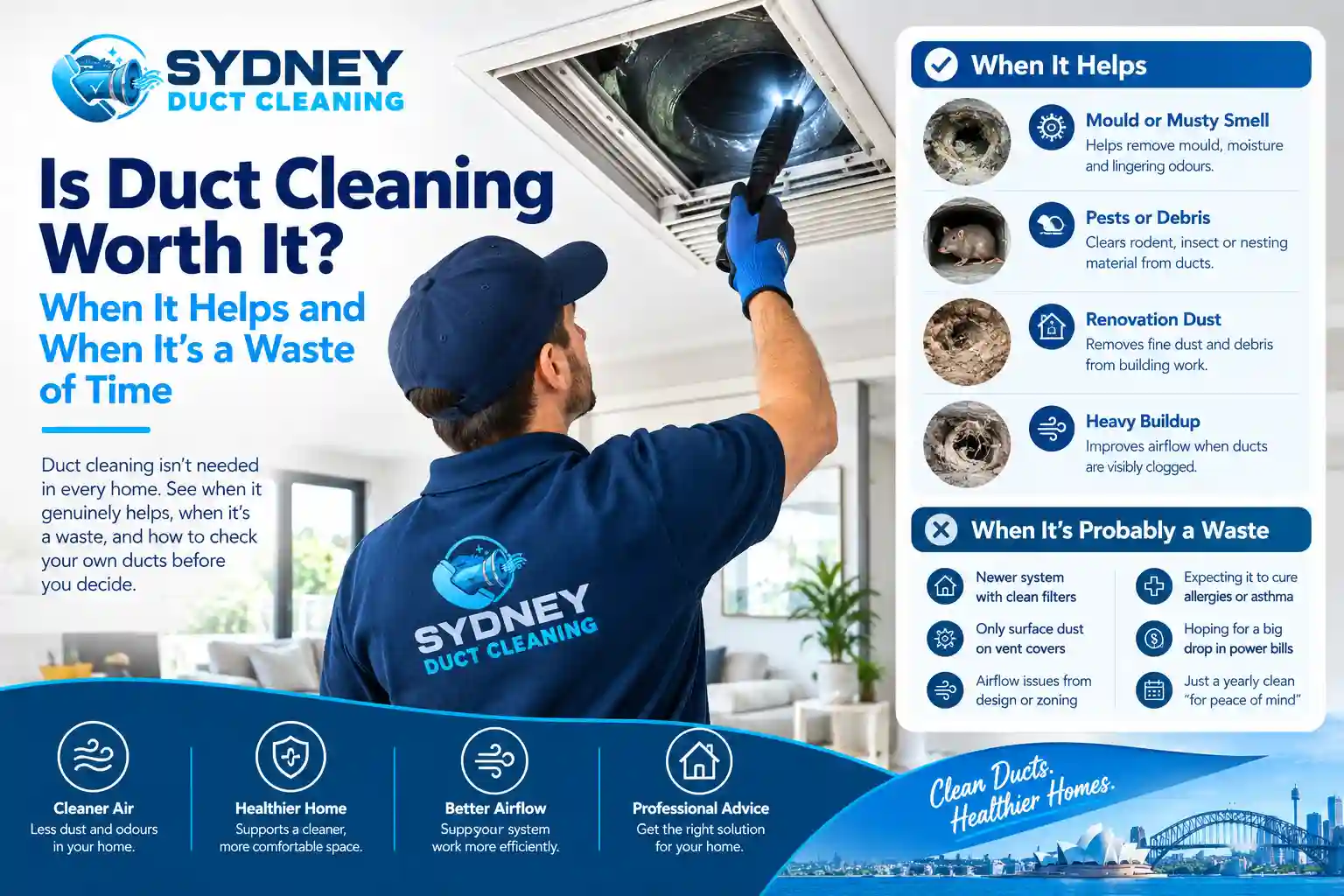
Sometimes. Duct cleaning is clearly worth it when you have mould, pests, heavy dust left by building work, or ducts that are visibly clogged. It’s usually not worth it when the system is fairly new, the filters are clean and nothing is wrong. Be wary of anyone who says every home needs it every year, and equally of anyone who says it’s never necessary.
The honest answer depends on what’s actually inside your ducts, and you can find that out before spending anything.
The quick answer
| Likely worth it | Probably not yet |
|---|---|
| Visible mould or a persistent musty smell from the vents | A newer system with clean filters and no problems |
| Signs of rodents, insects or nesting material | Light dust on the outside of the vent covers |
| Building or renovation dust drawn into the system | A flyer or phone call saying “it’s time” |
| Water damage or flooding that reached the ducts | Hoping it will cure allergies by itself |
| Heavy, visible buildup or debris blowing out of the vents | Rooms that are hot or cold because of how the system was designed |
| Moving into a home with an unknown cleaning history | A yearly clean “just in case” on a lightly used system |
When duct cleaning is worth it
Mould or a musty smell. Ducts that sit in a hot, humid roof space can collect condensation, and moisture plus dust is what mould needs. If you can see mould, or a musty smell hits every time the system starts, the ducts should be inspected. Mould is not something to leave and hope for the best.
Pests. Rodents, possums and insects can get into ducts and roof spaces. Droppings, nesting material and the occasional dead animal are good reasons to clean and sanitise, because the debris doesn’t go away on its own and airflow carries odours and particles through the system.
Renovation or construction dust. Plaster, sawdust and brick dust are fine and plentiful, and they get pulled into return vents, especially if the system ran during the work. This is one of the most clear-cut cases for cleaning.
Water damage. If a roof leak, burst pipe or flood reached the ducts or the unit, damp insulation and ductwork can grow mould quickly. Inspect early.
Heavy visible buildup. If you remove a vent cover and see thick, matted dust or debris, or dust blows out when the system starts, there’s something to clean. A thin film of dust is normal. Layers of it are not.
A new home with an unknown history. You don’t know how well the previous owner or tenant looked after the system, or whether there were pets, smokers or pests. An inspection gives you a baseline, and cleaning makes sense if it shows buildup.
When it’s probably a waste of time
The system is newer and the filters are clean. If you replace or wash the filter as needed and there are no symptoms, the ducts are likely in decent shape.
You’re only seeing surface dust. Dust on a vent cover is wiped off in seconds. It isn’t proof the ducts are dirty inside.
It’s meant to fix an airflow problem that isn’t about dirt. Hot or cold rooms are often caused by design, zoning, damaged ducts or a sensor in the wrong place. Cleaning won’t change those.
You expect it to cure allergies or asthma on its own. Cleaner ducts can reduce one source of dust, but they are rarely the only source. If someone in the home has asthma or allergies, a doctor is the right person to advise on that, and duct cleaning is one small part of the picture.
You expect a big drop in your power bill. A clogged system can use more energy, but most of the savings come from clean filters and a serviced unit, not the ducts alone.
It’s a reflex. “Every year, whatever happens” is a sales schedule, not an engineering one.
What the evidence actually says
It helps to be straight about this, because plenty of duct cleaning marketing makes bigger promises than the evidence supports.
Health agencies such as the US Environmental Protection Agency say there’s no strong proof that routine duct cleaning in a normal home prevents health problems. The same guidance recommends cleaning when there is visible mould, a pest infestation, or ducts that are clogged with enough dust and debris to be released into the living space. That matches how most careful operators think about it: clean when there’s a reason, not on autopilot.
It’s also worth remembering that ducts aren’t the only source of household dust. Much of it comes from everyday life, from fabrics, skin, pets and outdoor air that comes through doors and windows. Ducts can add to it when they’re dirty, but cleaning them won’t make a dusty home dust-free.
Why Sydney homes can tip the balance
A few local factors make duct problems more likely here than in a cooler, drier city:
- Humidity: condensation and damp roof spaces raise the chance of mould in ducts.
- Roof-space ducts: most ducted systems run through the roof, where heat, dust and pests all collect.
- Constant building and renovation: fine dust gets everywhere.
- Long cooling seasons: more running hours move more air, and more dust, through the system.
None of these mean you automatically need a clean. They mean it’s worth checking rather than assuming your ducts are fine.
How to check your own ducts first
You can gather useful evidence in about fifteen minutes:
- Look into the vents with a torch. Remove a supply vent cover if it comes off easily, and look for thick dust, debris, dark spots or anything that looks like mould.
- Check the return grille and filter. A filter coated in grey, matted dust points to a system that is struggling. Our air filter replacement page explains when to clean or replace it.
- Do a smell test. Run the system from cold. A musty, sour or burnt smell that appears on start-up is a flag.
- Watch for patterns. Note whether symptoms, such as sneezing or dusty rooms, are worse when the system runs.
- Look for pests. Droppings near vents, scratching sounds in the ceiling or sightings in the roof space are all worth acting on.
If you find nothing, it’s perfectly reasonable to wait and keep the filters clean. If you find something, you now have a concrete reason, which is worth far more than a general suggestion to clean.
What a trustworthy operator should do
If you decide to get an inspection, a good provider will:
- Show you what’s inside the ducts, with photos or a camera, rather than asking you to take their word for it.
- Explain what they found and why it needs cleaning, or tell you plainly that it doesn’t.
- Explain what their clean involves and what it can’t fix.
- Keep their claims realistic and avoid promises about curing medical conditions.
Warning signs include pressure to book on the spot, scare stories about what’s “in your air”, a promise of dramatic health results, a refusal to show the inside of the ducts, or advice that every home needs cleaning every year. If you’d like to see what a proper duct clean involves so you know what to expect, our air duct cleaning and residential air duct pages go through the process.
What duct cleaning won’t fix
Knowing the limits stops you paying for the wrong solution:
- Rooms that never cool or heat properly, which are often a design or duct damage issue
- A noisy or failing unit
- An undersized system
- Poor insulation in the roof or walls
- A dirty outdoor unit or blocked drain
- Moisture problems that are still active, such as a roof leak
If the cause is elsewhere, cleaning the ducts will leave the problem exactly where it was.
A simple way to decide
- Visible mould, pests, water damage or renovation dust: get the ducts inspected and cleaned if needed.
- Heavy buildup, strong smells or poor airflow: check the filter first, then have the system inspected.
- Just moved in: inspect once to set a baseline, then clean only if the results justify it.
- No symptoms, a newer system and clean filters: keep the filters clean, check again in a couple of years and don’t clean for the sake of it.
The takeaway
Duct cleaning is worth it when there’s a real reason, and a waste when there isn’t. Look for mould, pests, building dust, water damage or heavy buildup, check your own vents and filter first, and insist on seeing what’s inside before agreeing to anything. A provider who tells you “you don’t need it yet” is usually one worth trusting later.