
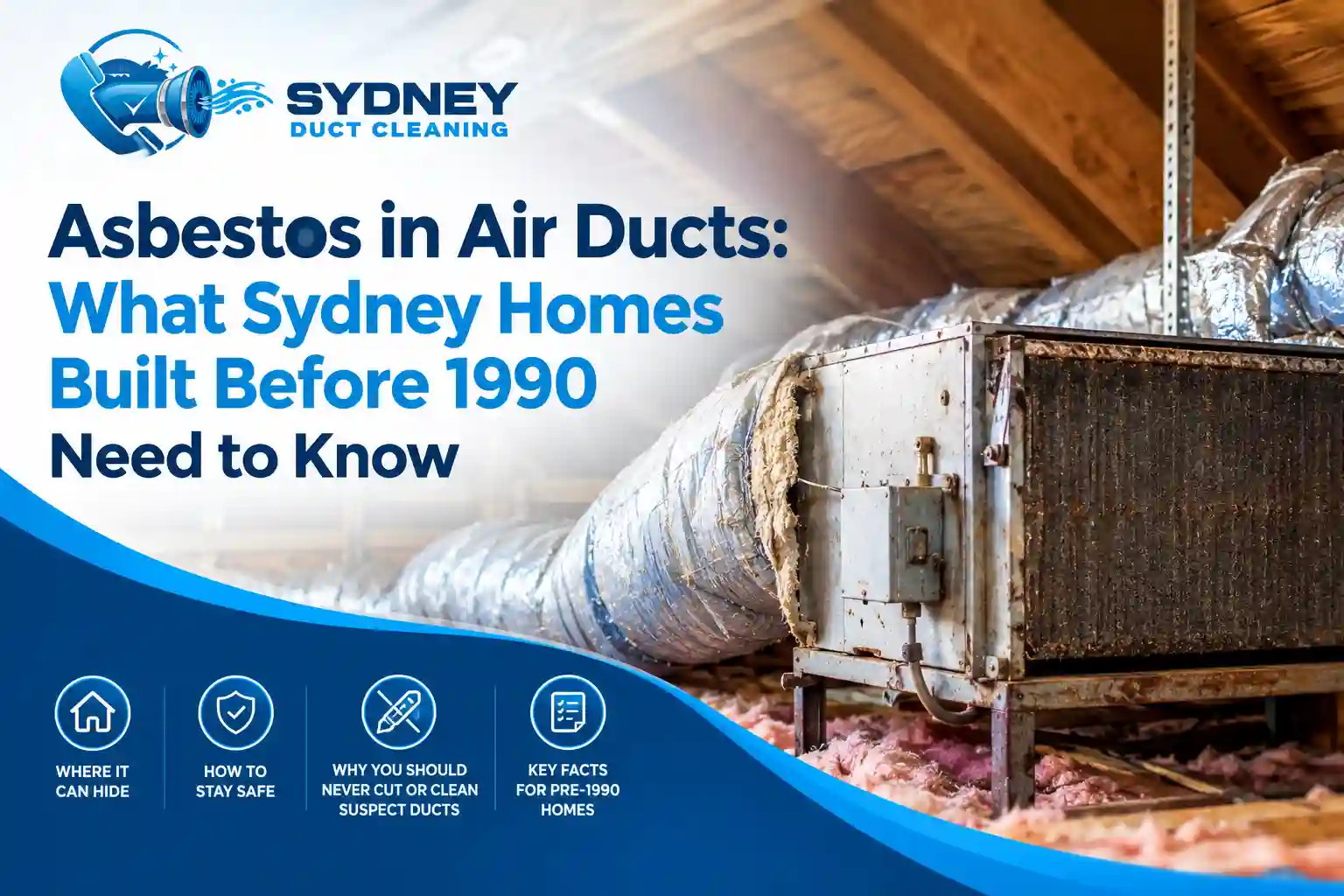
Asbestos in air ducts is uncommon in newer Sydney homes, but it can turn up in older ones, usually in components such as old heater banks, duct wrap, lagging and tape. If your home was built or renovated before 1990, it’s reasonable to assume some materials may contain asbestos until a licensed professional confirms otherwise. The most important rule is simple: don’t cut, drill, brush, vacuum or break up anything you suspect, because disturbed asbestos is where the danger lies.
Undisturbed asbestos in good condition is generally not an immediate risk, so there’s no need to panic. But there are good reasons to understand where it can hide in a ducted system and what to do about it.
Why asbestos in air ducts is a real question for Sydney homes
Asbestos was used widely in Australian building products until it was banned in 2003. A Parramatta council fact sheet notes that asbestos-containing materials are still common in homes built before 1990. Other council guidance says homes built before the mid-1980s are highly likely to contain some, and those built between the mid-1980s and 1990 are likely to.
Ducted heating and cooling systems fall into the same picture. The national asbestos agency’s product database lists asbestos heater banks used in ducted air conditioning in houses before 1990, and a SafeWork SA safety alert has warned building owners about asbestos millboard lining in heating ducts.
Most ducted aircon in Sydney homes is more recent, so many systems will have no asbestos in them at all. The risk is greater in older homes, in systems installed or modified before 1990, and in renovations that reuse old parts.
Where asbestos in air ducts can be found
| Part of the system | What to know |
|---|---|
| Heater banks and the compartment around them | Asbestos millboard was used to line spaces around heating elements in ducted systems before 1990. |
| Duct wrap or lagging | Some older ducts were wrapped in asbestos-based paper or cloth for insulation. |
| Tape and sealing material | Older tape used on joints and seams may contain asbestos. |
| Vibration dampers and connectors | Flexible joins near the unit were sometimes made with asbestos-containing material. |
| Flues and heater components | Some old flue pipes and heater parts contain asbestos cement or similar materials. |
| Roof-space insulation and sheeting | Where ducts run through the roof, nearby materials from the same era may also contain asbestos. |
You can’t tell by looking. Asbestos looks like many harmless materials, and testing by a laboratory is the only way to know.
Why disturbed asbestos is the danger
The health risk comes from breathing in fine fibres. Asbestos that is intact and left alone generally doesn’t release them. Asbestos that is damaged, crumbling or disturbed can, and inhaled fibres are linked to serious lung diseases, including asbestosis and mesothelioma, often decades after exposure.
A ducted system adds one more factor. If asbestos material sits in the path of the airflow and it’s damaged, the system can carry fibres through the ducts. That’s why damage to old ducts or heater components is treated more seriously than the same material sitting in a wall.
Seven facts about asbestos in air ducts
- Age is the biggest clue. Homes and systems built before 1990 are the main concern, and before the mid-1980s even more so.
- You can’t identify it by sight. Only a sample analysed by an accredited laboratory can confirm it.
- Intact and undisturbed is the safest state. The risk rises when material is damaged, cut, drilled or removed.
- Heater banks are a known hot spot. The millboard lining around old ducted heating elements is one of the most documented sources.
- Renovation is the common trigger. Cutting into ceilings, replacing a unit or removing old ducts can disturb material that has sat quietly for decades.
- Normal cleaning methods can make it worse. Brushing, vacuuming with an ordinary vacuum or using compressed air can spread fibres.
- Removal is regulated. Work on suspect material should be handled by appropriately licensed professionals, not by guesswork.
What to do if you think you have asbestos in air ducts
- Find out when the home and the system were built. The year is your first clue, and it helps an assessor decide what to test.
- Look, but don’t touch. Note any damaged, frayed or crumbling wrap, board or tape, and photograph it from a safe distance. Don’t pick, scrape or poke it.
- Leave the roof space alone. Don’t go up there to investigate, because the roof space is hot, hazardous and may contain other asbestos-containing materials.
- Consider switching the system off if you can see damaged material in the airflow path, until it’s been assessed.
- Arrange testing through a licensed professional. A licensed asbestos assessor can inspect the system, take samples and send them to an accredited laboratory.
- Follow the assessor’s advice on whether to leave the material alone, seal it or have it removed by a licensed removalist.
What not to do
- Don’t cut or drill into suspect ducts or boards. That is the quickest way to release fibres.
- Don’t brush or vacuum them. Household vacuum cleaners can blow fibres back into the room.
- Don’t use compressed air or high-pressure water. Both spread fine particles.
- Don’t remove them yourself. Taking apart an old heater bank or stripping lagging is not a DIY job.
- Don’t assume it’s fine because it looks fine. Old materials often look alike.
- Don’t ignore it before a renovation. Test first, then plan.
How this affects duct cleaning
This is where asbestos in air ducts matters directly to a duct cleaner. A responsible provider will ask about the age of the home and the system, and will stop and recommend assessment before cleaning if there’s any sign of old lagging, millboard or damaged material. Most cleaning methods involve agitation and suction, and they are not designed for asbestos-containing material.
That is one more reason an inspection should come before any clean. If you’d like to see how a proper inspection and clean is done in a newer, unaffected system, our air duct cleaning and residential air duct pages explain the process. Commercial buildings from the same era have their own considerations, which our commercial air duct cleaning page touches on.
Where Sydney homes are most likely to be affected
- Older homes in established suburbs, such as the Inner West, North Shore, the Eastern Suburbs and long-established parts of Western Sydney, where houses from the 1950s to 1980s are common.
- Homes with older ducted heating, especially original heater banks that were never replaced.
- Renovated or extended homes, where an old system was modified or extended using older parts.
- Converted or older commercial and apartment buildings, where ducted systems from before 1990 may still be in use.
Houses built after 1990 are far less likely to be affected, but the cut-off isn’t a guarantee, because older stock and imported components were still in use for a time.
What a licensed assessor actually does
Many people put off testing because they’re unsure what it involves. In general, a licensed asbestos assessor will inspect the areas you’re concerned about, record the age and condition of suspect materials and take small samples where needed. The samples go to an accredited laboratory for analysis, and you receive a written report.
The report tells you what was found, where it is, what condition it’s in and how it should be managed, which might mean leaving it in place, sealing it or arranging removal. It’s also a useful record to keep with your house documents, since it answers the question for every future tradesperson who works on the system.
Myths about asbestos in air ducts
“Asbestos was only used in fibro sheeting.” Fibro is the best-known example, but asbestos went into hundreds of products, including parts of heating and cooling systems.
“It was banned in 2003, so it’s all gone.” The ban stopped new use. It didn’t remove asbestos already installed in existing buildings.
“My ducts are flexible and modern, so I’m safe.” Modern flexible ducts are very unlikely to contain asbestos. But an older heater bank, old connectors or other materials nearby may still be original, so it’s the age of each part that counts.
“A quick dust-off is harmless.” A quick brush or vacuum is exactly the sort of disturbance that releases fibres from damaged material.
“A dust mask makes DIY safe.” A basic mask doesn’t make it safe to disturb asbestos. Licensed professionals use specific equipment and procedures for that reason.
What to check before you renovate or replace a unit
The riskiest moment for asbestos in air ducts is when someone is about to take something apart. Before any work that touches the ducts, ceiling or heater compartment in a pre-1990 home:
- Tell every tradesperson the age of the home and system.
- Ask for an asbestos inspection if the home was built or renovated before 1990.
- Wait for results before cutting new vents, removing old ducts or replacing an old heater.
- Keep the report, because it helps with future work and with selling the property.
The takeaway
Asbestos in air ducts is not something every Sydney home needs to worry about, but it’s worth taking seriously in a house built before 1990, especially one with an older ducted system or an upcoming renovation. Intact material is generally low risk, but disturbed material is dangerous, and you can’t tell by looking. Leave it alone, get it tested by a licensed professional and have the answer before any cutting, cleaning or replacing begins.