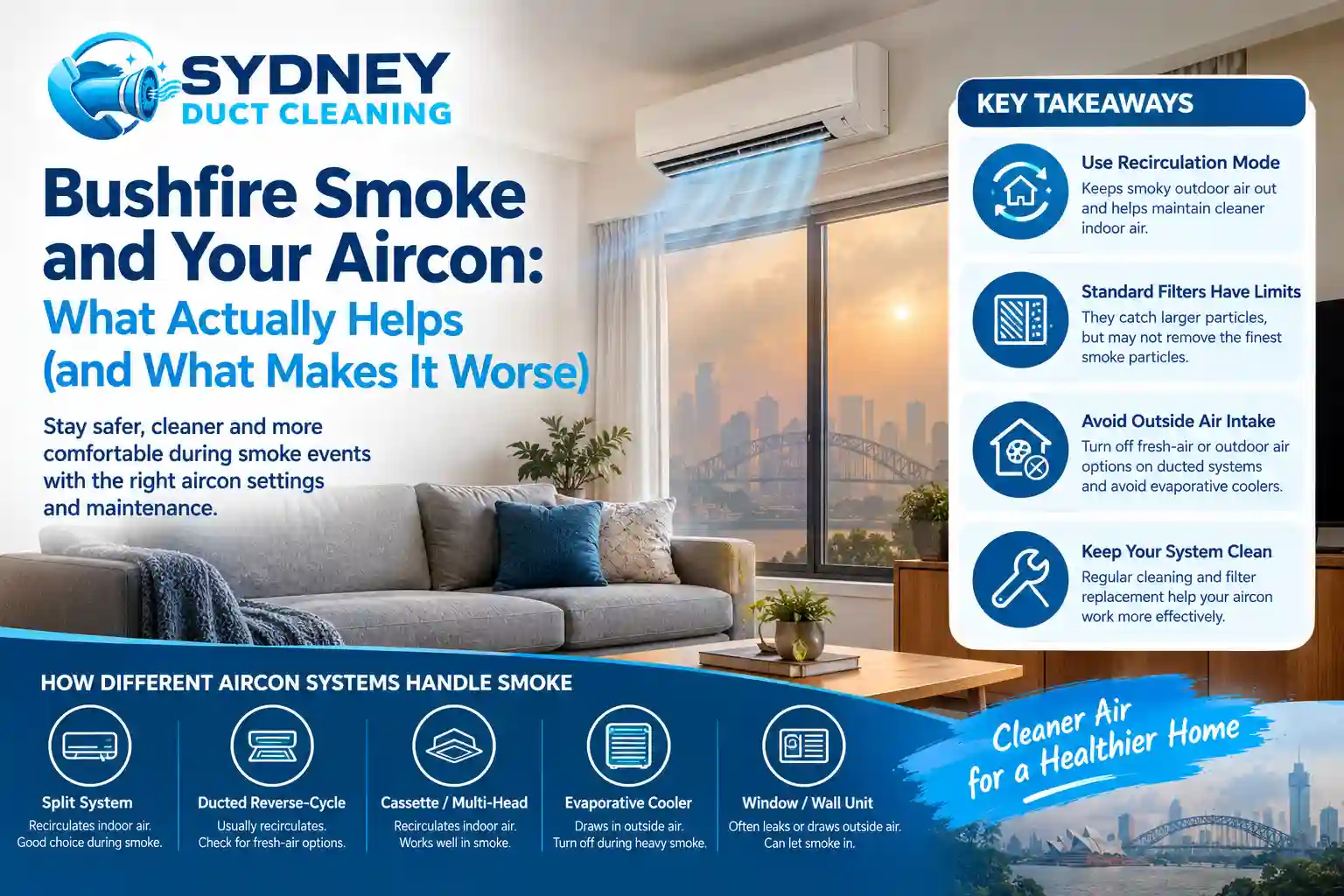
During a smoke event, your aircon can help or hurt depending on what type you have and how it’s set. A split system that recirculates indoor air, with windows and doors shut, keeps smoke out better than almost anything else in a typical home. An aircon that pulls in outside air, such as an evaporative cooler or a window unit, can bring smoke straight inside.
There is one catch that surprises people. Even a recirculating system won’t remove the finest smoke particles, because the standard filters in most home units aren’t built to catch them. Knowing that changes what you do, and what you should sort out before summer arrives.
Why smoke is harder to deal with than dust
Bushfire smoke is made of tiny particles, many far smaller than household dust. That size is the whole problem. The smaller the particle, the more easily it slips through ordinary filters and the deeper it can travel into the lungs.
The 2019 to 2020 fire season showed Sydney how long smoke can hang around. With smoke lingering for days or weeks, the usual advice to stay indoors only works if the inside of your home stays cleaner than the outside. That depends on how much outdoor air is leaking or being drawn in, and what your aircon does with the air.
What your aircon type does during smoke
The most useful thing you can learn before the next smoke event is whether your system recirculates indoor air or pulls in outside air.
| Aircon type | What it does with air | During smoke |
|---|---|---|
| Split system | Recirculates indoor air | Generally the better choice. Keeps cooling without drawing smoke in, but standard filters don’t capture the finest particles. |
| Ducted reverse-cycle | Usually recirculates, but some setups have an outdoor air or fresh-air option | Check whether yours can bring in outside air, and turn that off if so. |
| Cassette or multi-head | Recirculates indoor air | Similar to a split system. |
| Evaporative cooler | Draws outside air in by design | Can make indoor air worse. Best switched off during heavy smoke. |
| Window or wall unit | Often draws some outside air or leaks around the frame | Can let smoke in. Seal gaps where possible. |
If you aren’t sure which type you have, the model number on the indoor unit or controller is a good place to start, and a technician can confirm it quickly.
Why your standard filter isn’t enough on its own
Research from UNSW after the 2019 to 2020 fires made an important point: a recirculating aircon will keep you cooler, but most domestic aircon filters cannot remove the very small particles that make smoke dangerous.
That doesn’t mean the system does nothing. A UTS-led study of office buildings found that air conditioning filters did trap particles from bushfire smoke and reduced indoor exposure, which shows the filters contribute. The difference is that those were commercial systems, and the filters in a typical home split unit are a lot more basic. They are designed mostly to protect the unit from dust and to catch larger particles, not to clear smoke.
So the right way to think about it is this: your aircon is a good tool for keeping the home sealed and cool, and a limited tool for cleaning the air.
What to do when smoke arrives
Here is a practical order of steps for a smoke day.
- Close windows, doors and vents. Sealing the home reduces the rate at which outside air replaces inside air. Gaps under doors and around old windows are common leaks.
- Switch to recirculation. Use the aircon in its normal recirculating mode, and close any outdoor air or fresh-air option on a ducted system.
- Turn off anything that draws outside air. Evaporative coolers and exhaust fans that pull air from outdoors work against you.
- Use a HEPA air purifier if you have one. To work properly against smoke, a purifier needs a true HEPA filter. Many products sold as air purifiers don’t filter fine particles at all, so check the specifications. Each purifier also covers a limited area, so run it in the room where you spend the most time.
- Cut indoor pollution sources. Avoid candles, gas stoves where possible, and vacuuming with a non-HEPA vacuum, as these add particles on top of the smoke.
- Follow health advice if you are sensitive. People with asthma, heart or lung conditions, young children and older adults should follow the plan their doctor has given them and check the NSW air quality information for guidance on the day.
One honest limit: there is no complete fix at home. If smoke is thick and persistent, the most reliable option is to spend time somewhere with a recirculating, HEPA-filtered air conditioning system, such as certain public buildings, or somewhere the air quality is better.
Get your system ready before the smoke arrives
Smoke events can strike with little warning, so the best time to prepare is now, before summer.
Check and clean your filters. A clogged filter restricts airflow, makes the unit work harder and makes it less effective at everything. Make sure yours is clean and in good condition. Our guide to air filter replacement explains when a filter needs replacing rather than just washing.
Ask about better filtration. Some systems can take higher-grade filters, and others can’t, so what’s possible depends on your model. A technician can tell you what suits your system without hurting airflow.
Find out how your system handles outside air. If you have ducted aircon, ask whether there is an outdoor air or fresh-air feature and how to turn it off.
Service the unit. A clean coil, drain and filter keep the system running efficiently through long periods of continuous use, which smoke events often involve. Cleaning your split system or having your air con cleaned before the season starts means it is ready when you need it.
Seal the home. Door seals, window seals and gaps around old fittings are cheap to fix and make a real difference.
Buy supplies early. If you plan to use a HEPA purifier or spare filters, buy them before a smoke event, when everything sells out fast.
After the smoke clears
Once air quality improves, a few steps help your home recover.
- Open the house up. When outdoor air quality is good again, open windows and doors to flush out stale indoor air.
- Check your filters. After days of heavy smoke, filters may be darker and more loaded than usual. Clean or replace them.
- Wipe vents and grilles. Smoke leaves a fine residue that settles on surfaces, including aircon vents.
- Pay attention to smell. If a smoky odour lingers when the aircon starts, the system may have taken in smoke particles. A clean and inspection can help. If you have ducted aircon, our air duct cleaning page explains what a duct clean involves.
It is worth being straight about what cleaning can and can’t do. Cleaning your ducts will not protect you from smoke while it’s in the air, and it isn’t a substitute for sealing the home and using a proper purifier. What it can do is remove residue afterwards and get your system back to a clean starting point.
Common mistakes to avoid
- Assuming the aircon cleans the air. It cools the air. Filtration is limited.
- Running an evaporative cooler in heavy smoke. It draws the smoke in.
- Leaving the fresh-air option on with a ducted system.
- Buying a purifier without a true HEPA filter.
- Waiting until smoke arrives to check the filter. By then, it’s too late to fix easily.
- Taping over vents without checking. Blocking a vent can cause problems with your system, so ask a technician before sealing anything connected to your aircon.
The takeaway
In smoke, a recirculating aircon is your friend and one that draws outside air is not. Don’t count on standard filters to clear fine smoke, so seal the home, run the system in recirculation mode and add a proper HEPA purifier if you can. Then use the weeks before summer to clean the filters, check how your system handles outside air and get it serviced, so it’s ready before the first smoky day.